
Federal Ministry of the Interior

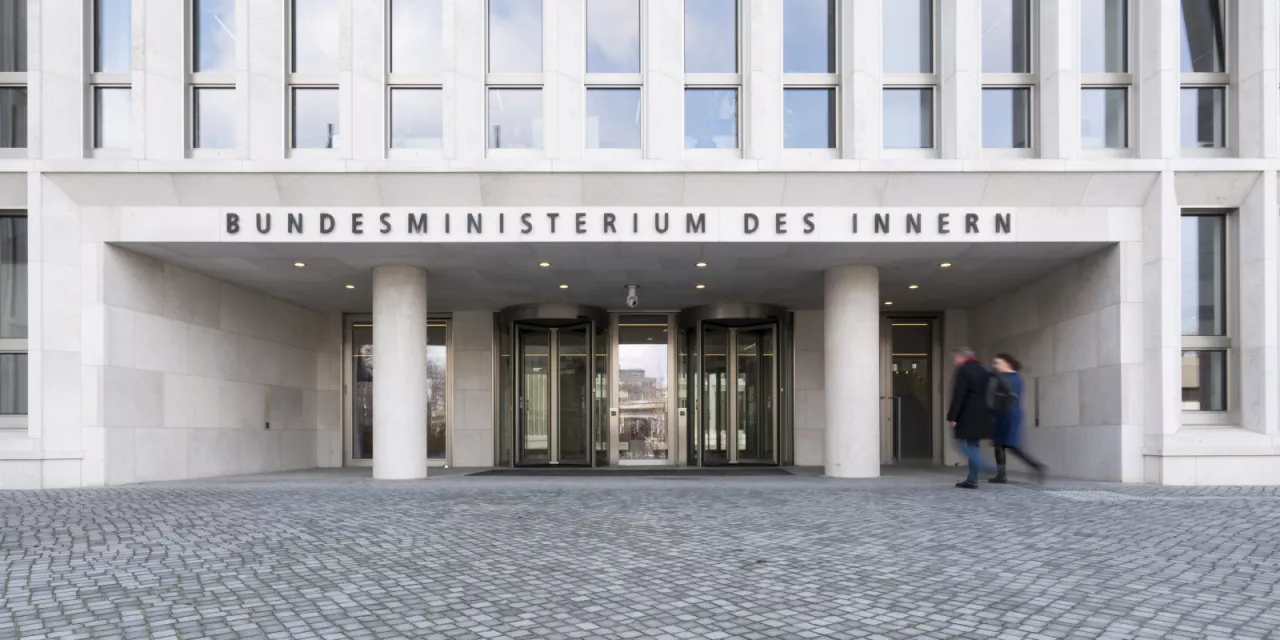
The BigBrotherAward in the “Authorities and Administration” category goes to the
Federal Minister of the Interior, Alexander Dobrindt,
for creating a number for everything that the state knows about us – disguised as a harmless “residents register modernisation”.
In the past, an entry in a registry office would say, roughly, “Peter Schmidt is the child of his parents, Manfred Schmidt and Carola Müller”. In the future, identifying a person unambiguously will depend on a number: “531546 is the child of parents 879923 and 239332”. This has been prescribed in the Registry Modernisation Law and the Identifying Number Law put forward by the German government.
More and more government services are supposed to be digitalised and simplified. In the first instance we should welcome this. Why, when registering to be married in 2026, should it be necessary to wait several weeks and then send paper documents across the country? Or why, when applying for welfare payments, do we need to re-submit certain proofs over and over, and separately to several places? That’s why the EU and Germany are working to implement the “once-only principle”. The idea is that documents need to be submitted just once, not any more than that.
There are various technical ways to implement this. In Germany the agreed procedure is focused on document retrieval. If, for example, an application for welfare payments is processed and some proof is needed, the agency will consult a directory of government institutions to find where the proof can be obtained. Then the documents – such as proofs of income, or registry data – will be retrieved via a data interface.
To prevent government agencies from accessing each others’ data without just cause, so-called “clearing houses” have been conceived. These are supposed to check the permission to access the data. But in practice, there is no check as to whether the request is legal. The only check is for formal correctness and whether the requesting institution is authorised in principle. And in any case, these clearing houses are simply inserted into the process and could just as easily be removed. So there is no real technical hurdle for an agency getting full access to the data.
At least there is the plan to create a “data cockpit” where citizens can see which data was accessed.
To ensure that accessed data is related to the right person, the government has decided to introduce a unique person identifier. The idea is to ensure that there is no mix-up, for example between people with the same name.
In Germany it was decided that the identifier to use would be the Tax ID, which is assigned to each of us at birth. That is a drastic repurposing of the Tax ID, which at the time of its introduction – as you might guess – was intended exclusively for administrating taxes.
We foresaw this exact misappropriation when we gave a BigBrotherAward for the introduction of the Tax ID in 2007.1 In 2020, when the registry modernisation was enacted, we gave an award to the Conference of interior ministers of the German federal states for transforming the Tax ID into a unique personal identifier.2 Now we also know the way the Tax ID is to be used to retrieve data in the context of registry modernisation:
Residents register, civil status registry office, vehicle register, banks, welfare payments – even for health data and someone’s educational history, the Tax ID has been chosen as the designated identifier. The Tax ID is now set to be used by more than 50 registries3. The intention is that all state databases will use this identifier eventually.
The “transparent citizen” – that is the term used by the German Federal Constitutional Court for the threat that data from many areas of life could be combined to create an encompassing personality profile. The introduction of a unique personal identifier for all registries is a “decisive step” towards the “transparent citizen”, as the Constitutional Court itself said.4 And this is exactly what the then Federal Commissioner for Data Protection, Ulrich Kelber warned about5 during the legislative process.
A glance at German history shows why interconnecting personal information by the state is particularly perilous: From 1943, the Nazis planned to introduce a twelve-digit “‘Reich’ personal number”.6 They intended to bring files and registries from the various government agencies together in a central “‘Reich’ person register” …
What consequences can arise if the state has a comprehensive view of the whole person can currently be observed in Russia:
To recruit enough soldiers for their war of aggression against Ukraine, the recruits register was modernised.7 It automatically merges information from various state registers. This way, people due for military service can be centrally identified and drafted. Those who do not show up are no longer allowed to drive a car, own real estate or conduct business with banks. All this is stored in the centralised database.
In the USA the immigration agency, ICE uses all information it can obtain to deport supposedly illegal immigrants. Via analysis software sold by Palantir, personal data is connected and processed to prepare for seizure by enforcement agents.8
Many people will respond to these examples by saying: “That would never happen here!” To clarify: It is true that no central ‘super register’ will be created – only the technical means to find and access these data. For now, this depends on the consent of the affected citizens. For now. But with automated interfaces for data access and the unique personal identifier, governments will have the tools to do much more. What is crucial therefore is not how the identifier can be legally used today. It is the desires that this infrastructure will create in the future. Especially if the political situation shifts.
We do wish for a more efficient administration, without dusty piles of folders. But we do not want an infrastructure to be created for this purpose that also enables the state to identify people across all areas of government with a single identifying key.
There are better solutions, for example, in Austria: They do have a central key. But identification is always limited to the respective administrative area.9 Further hurdles to prevent agencies helping themselves to data and to give citizens more control could be devised.
Despite all experts’ concerns and warnings, the implementation of the “National Once-Only Technical System” (NOOTS) has started.10 And it will be virtually impossible to stop it.
The question who is politically responsible for this is not easy to answer. The technical solution was worked out by a steering group between the federal and state levels. Currently, the political lead for registry modernisation lies with the Ministry for Digital Transformation and Government Modernisation. But the legal foundation was created by the Interior Ministry. That is what counts.
Mr Dobrindt, even if you only “inherited” the registry modernisation project – your ministry is politically responsible. For this, you are given the BigBrotherAward in the “Authorities and Administration” category. Congratulations!
Laudatio
1 https://bigbrotherawards.de/2007/peer-steinbrueck
2 https://bigbrotherawards.de/2020/innenministerkonferenz-bundesrepublik-deutschland
3 https://registerlandkarte.de/hauptfenster/registers?size=10&page=0®isterNachIdNrG=true&sort=name%2CASC
4 Bundesverfassungsgericht, Urteil vom 15. Dezember 1983, 1 BvR 209/83 u.a. (Volkszählungsurteil) [German Federal Constitutional Court, census ruling of 1983], BVerfGE 65, 1, Rn. 191, https://www.bundesverfassungsgericht.de/SharedDocs/Entscheidungen/DE/1983/12/rs19831215_1bvr020983.html.
5 https://background.tagesspiegel.de/digitalisierung-und-ki/briefing/zentrales-personenkennzeichen-angst-vor-dem-allwissenden-staat
6 Reichspersonalnummer, https://de.wikipedia.org/wiki/Reichspersonalnummer.
7 https://www.tagesspiegel.de/internationales/digitalregister-statt-einberufung-auf-papier-so-will-es-russland-schwerer-machen-sich-dem-kriegsdienst-zu-entziehen-12586925.html
8 https://www.americanimmigrationcouncil.org/blog/ice-immigrationos-palantir-ai-track-immigrants/
9 https://www.bundeskanzleramt.gv.at/agenda/digitalisierung/stammzahlenregisterbehoerde/bereichsspezifische-personenkennzeichen/beschreibung.html
10 https://www.digitale-verwaltung.de/SharedDocs/downloads/Webs/DV/DE/NOOTS-technical-design-documents-1-3.pdf?__blob=publicationFile&v=3